
NEC 2026: Load Calculations Move from Article 220 to Article 120
If you open the 2026 NEC looking for 220.82, you won’t find it. Here’s what moved, what changed, and what it means for your next service calculation.
Load calculations, the rules you use to size every service, feeder and branch circuit, have moved to a new Article 120 in Chapter 1. The new edition also changes one of the most-used numbers in residential design: the dwelling general lighting load.
The short version
- Article 220 is now Article 120. Load calculations moved from Chapter 2 to Chapter 1.
- Energy management moved too. Article 750 is now Article 130.
- Most section numbers keep their ending:
220.41→120.41. - Dwelling lighting load drops from 3 VA/ft² to 2 VA/ft² for service and feeder calcs.
- New
120.13keeps 3 VA/ft², but only to count branch circuits.
Why did load calcs move to Chapter 1?
Chapter 2 covers wiring and protection. Load calculations reach much further: they apply to services, feeders, equipment and special occupancies throughout the Code. Putting them in Chapter 1, next to the general requirements in Article 110, reflects that they apply everywhere.
Energy management systems followed the same logic. An EMS can now cap the load you use in a calculation, so it makes sense for Article 130 to sit next to Article 120. The 2026 edition is also a step toward a larger reorganization planned for 2029, which a new informative Annex L previews.
Old vs new: where to find it
| Topic | 2023 NEC | 2026 NEC |
|---|---|---|
| Load calculations (whole article) | Art. 220 | Art. 120 |
| Dwelling general lighting load | 220.41 | 120.41 |
| Dwelling branch-circuit count | — | 120.13 (new) |
| Feeder/service neutral load | 220.61 | 120.61 |
| RV park load calculations | Art. 551 | 120.30 |
| Energy management systems | Art. 750 | Art. 130 |
Tip: in most cases you can change “220” to “120” and keep the rest of the number. Always confirm in the 2026 book, because some sections were added or relocated.
The big one: 3 VA/ft² becomes 2 VA/ft²
For decades, dwelling general lighting and receptacle load was calculated at 3 VA per square foot. Under 120.41, the value for feeder and service calculations is 2 VA/ft².
Homes use far less lighting power than they did when the 3 VA value was set. LED lamps and DOE efficiency rules cut lighting loads sharply. A Lawrence Berkeley National Laboratory study of 896 occupied U.S. homes found a median lighting-and-receptacle density of about 2.3 W/ft².
Worked example: 2,400 ft² home, standard method
| Step | 2023 (220.41) | 2026 (120.41) |
|---|---|---|
| General lighting | 2,400 × 3 = 7,200 VA | 2,400 × 2 = 4,800 VA |
| Small-appliance + laundry (3 × 1,500) | 4,500 VA | 4,500 VA |
| Subtotal | 11,700 VA | 9,300 VA |
| After demand factors (first 3,000 VA at 100%, rest at 35%) | 6,045 VA | 5,205 VA |
That’s 840 VA less, or about 3.5 A at 240 V, for this house. The difference grows with floor area. On a 5,000 ft² home, the raw lighting load drops from 15,000 VA (62.5 A) to 10,000 VA (about 42 A) before demand factors.
This example assumes the demand factors carried over unchanged from Table 220.42 to Table 120.42. Check your 2026 book.
For most homes this won’t change the service size by itself. It can make a difference in larger homes, all-electric homes near a breakpoint, and existing homes where you’re trying to fit an EV charger or heat pump without an upgrade.
New 120.13: the circuit count stays at 3 VA/ft²
The 2026 Code didn’t want fewer branch circuits in new homes. So 120.13 still uses 3 VA/ft² to work out how many general-purpose branch circuits a dwelling needs. That number does not go into your service or feeder calculation.
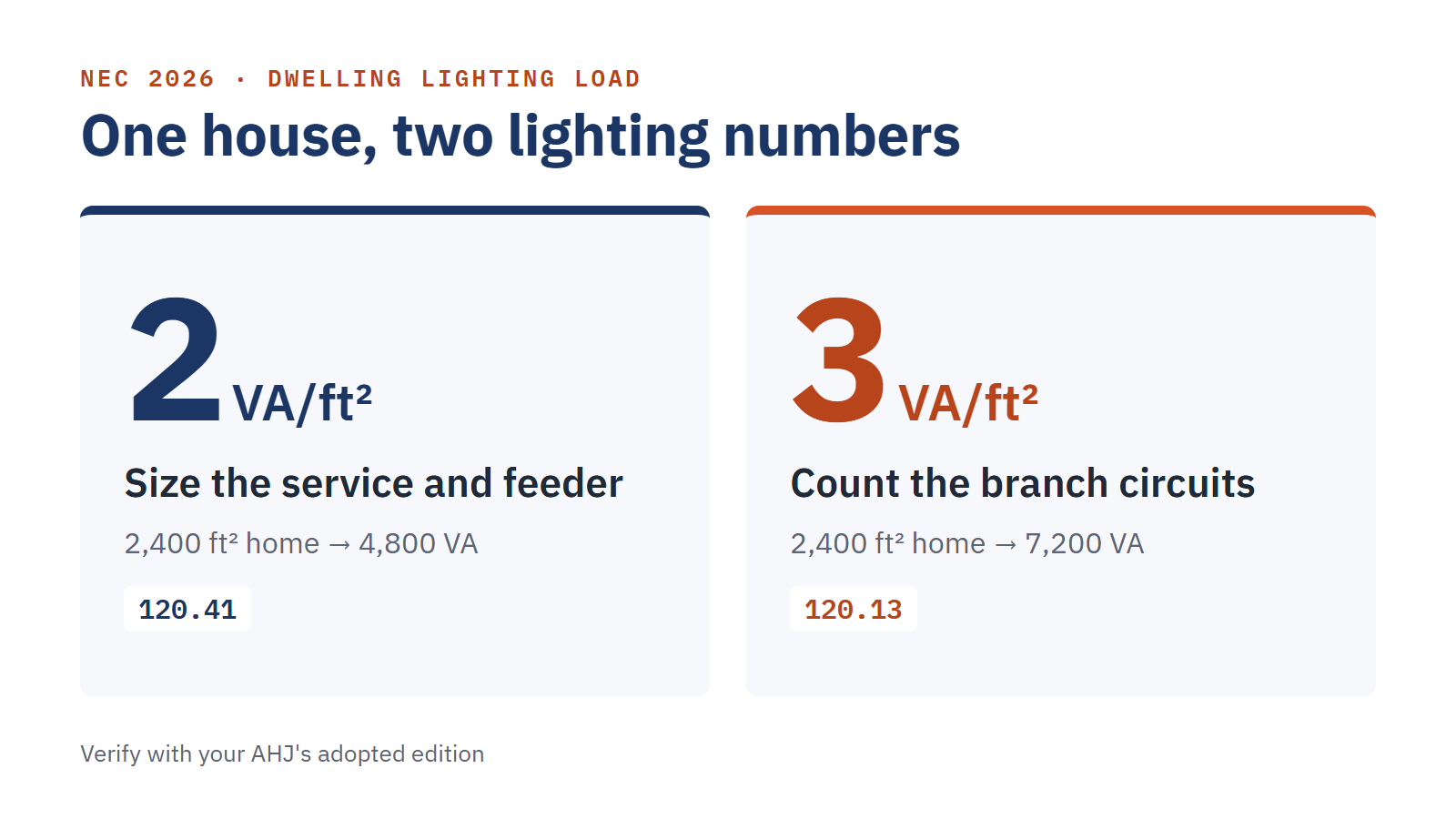
For 5,000 ft²: 5,000 × 3 = 15,000 VA, divided by 120 V gives 125 A. That means at least nine 15 A circuits or seven 20 A circuits, in addition to the small-appliance, laundry, bathroom and garage circuits required by 210.11(C).
Expect plan reviewers to check both. Mixing them up will be one of the most common corrections in the first year.
Which edition applies to your job?
The edition that counts is the one your state or AHJ has adopted. Many jurisdictions are still on the 2020 or 2023 NEC, and adoption of 2026 will roll out over the next few years. Before you calculate:
- Confirm the adopted edition and any local amendments.
- Cite sections from that edition on your plans (220.x or 120.x, not a mix).
- If you work in several jurisdictions, label every calculation with its edition.
Checklist for your next 2026 load calc
- Cite Article 120, not 220
- Use 2 VA/ft² for general lighting in the service or feeder calc (120.41)
- Check the branch-circuit count separately at 3 VA/ft² (120.13)
- Using an EMS to limit load? Reference Article 130, not 750
- Note the code edition on every sheet
Run the numbers
Enter the house, pick the method, and get a permit-ready PDF in minutes.
Educational content only. This article paraphrases and does not reproduce NFPA 70 text. Code adoption and amendments vary by jurisdiction. Verify with your AHJ and a licensed professional.
FAQ
Where is Article 220 in the 2026 NEC?
It moved to Article 120 in Chapter 1. Most section numbers keep their ending, so 220.41 becomes 120.41.
Is the dwelling lighting load still 3 VA per square foot?
For service and feeder calculations, the 2026 NEC uses 2 VA/ft² (120.41). The 3 VA/ft² value is kept only for counting branch circuits (120.13).
Where did energy management systems go?
Article 750 moved to Article 130 in Chapter 1.
Do I have to use the 2026 NEC now?
Only if your jurisdiction has adopted it. Check with your AHJ.