
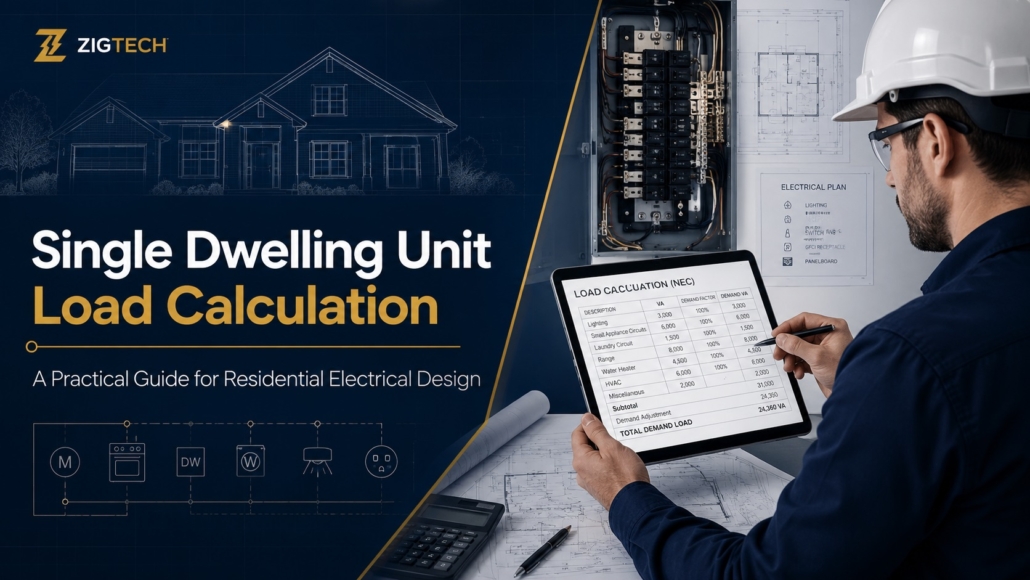
Is Your 200-Amp Service Still Enough? Why Single-Dwelling Load Calculation Is a Hot Topic
Modern homes are placing greater demands on their electrical systems.
Electric vehicle chargers, heat pumps, electric water heaters, induction ranges, dryers, home offices, workshops, solar equipment, and battery-storage systems can all influence the capacity required for a dwelling.
That makes an accurate single-dwelling-unit load calculation more important than ever.
A residential load calculation is not simply a list of appliance wattages. It is a structured process used to estimate the electrical demand that a dwelling may place on its feeder or service. The result helps electrical professionals determine an appropriate service size, feeder capacity, panel rating, and related equipment.
The National Electrical Code, published as NFPA 70, is a benchmark for safe electrical design, installation, and inspection. Under the 2023 NEC, branch-circuit, feeder, and service load calculations are principally addressed in Article 220. In the 2026 NEC, these requirements were reorganized into the new Article 120, so professionals should always confirm which NEC edition has been adopted by the local authority having jurisdiction.
What Is a Single-Dwelling Unit?
A single-dwelling unit is a self-contained residential space providing permanent provisions for living, sleeping, cooking, and sanitation.
Common examples include:
- A detached single-family house
- One unit of a duplex
- An individual apartment or condominium
- A residential unit within a mixed-use building
The calculation is completed for the electrical loads serving that dwelling. Shared building loads, common-area lighting, elevators, central mechanical equipment, and other non-dwelling loads may require separate treatment.
Why Connected Load Is Not the Same as Demand Load
One of the most important concepts in residential electrical design is the difference between connected load and calculated demand load.
Connected load is the sum of the electrical ratings of the equipment and systems connected to the installation.
Demand load is the amount of that connected load expected to operate simultaneously after the applicable demand factors and calculation rules have been applied.
A home might contain a range, dryer, water heater, air-conditioning system, dishwasher, disposal, EV charger, lighting, and numerous receptacles. However, it is unlikely that every load will operate at maximum capacity at exactly the same time.
NEC load-calculation procedures account for this diversity. The objective is to avoid both extremes:
- An undersized service that may be unsafe or unreliable
- An unnecessarily oversized service that increases project cost
Major Loads Included in a Dwelling Calculation
A complete calculation normally considers several load groups.
1. General Lighting and Receptacle Load
The dwelling floor area is used to establish a general load representing lighting and general-use receptacles.
This is not limited to installed light fixtures. It forms the base general load for the dwelling and must be calculated using the applicable NEC method.
Accuracy begins with the correct floor area. Measurements should follow the applicable code rules and should not automatically include every covered or attached space.
2. Small-Appliance Branch Circuits
Residential kitchens, dining areas, pantries, breakfast rooms, and similar spaces require small-appliance branch circuits.
These circuits contribute to the dwelling load calculation even when the final countertop appliances have not yet been selected.
They must not be omitted simply because the kitchen equipment is portable rather than permanently installed.
3. Laundry Circuit
The required laundry branch circuit is another component of the general residential load.
This load is separate from the rating of an electric clothes dryer. The laundry branch circuit may supply equipment such as a washing machine, while an electric dryer is addressed separately.
4. Fastened-in-Place Appliances
Permanently connected appliances can include:
- Dishwasher
- Waste-disposal unit
- Water heater
- Water-treatment equipment
- Built-in microwave
- Trash compactor
- Central vacuum
- Pool or spa equipment
- Other fixed residential equipment
The nameplate rating of each applicable appliance should be recorded carefully. Using assumptions when an equipment schedule or manufacturer’s data is available can produce an inaccurate result.
5. Cooking Equipment
Electric ranges, wall-mounted ovens, cooktops, and other household cooking appliances require special attention.
Cooking equipment may be subject to specific demand rules. Simply adding every appliance nameplate rating and treating the total at 100 percent may not produce the correct calculated demand.
The calculation must also distinguish between one complete range and separate cooking components.
6. Electric Clothes Dryer
An electric dryer is included using the applicable NEC requirement and the equipment nameplate information.
Gas dryers may have a relatively small electrical requirement, but electric dryers can represent a substantial load and must be identified correctly.
7. Heating and Air-Conditioning
Heating and cooling equipment can significantly affect service size.
The calculation may need to consider:
- Central air-conditioning
- Heat pumps
- Electric furnaces
- Electric resistance heating
- Air handlers
- Supplemental heat
- Multiple HVAC systems
Special attention is required when heating and cooling loads are noncoincident. Loads that cannot operate at the same time may not always be treated in the same way as loads that can operate simultaneously.
Supplemental or emergency electric heat can also change the calculation significantly.
8. Electric Vehicle Charging
EV charging is becoming one of the most important considerations in residential service design.
The calculation should consider:
- Charger or EV supply equipment rating
- Continuous-load treatment where applicable
- Whether load-management equipment is used
- Existing service capacity
- Future charging requirements
- Whether more than one EV may be charged
Adding an EV charger without reassessing the dwelling load can result in a service or feeder that is no longer adequate.
9. Additional and Future Loads
Modern projects may also include:
- Solar photovoltaic equipment
- Battery-energy storage
- Electric water heating
- Sauna or steam equipment
- Pools and spas
- Workshops
- Accessory dwelling units
- Outdoor kitchens
- Well pumps
- Standby systems
- Future electrification allowances
Not every item is calculated identically, but all relevant equipment must be identified before the service size is selected.
Standard Method Versus Optional Method
Dwelling load calculations may be completed using different NEC-permitted methods, depending on the installation and its eligibility.
Standard Calculation
The standard method calculates individual load groups and applies the relevant rules and demand factors to each category.
It offers a detailed view of the dwelling loads but requires careful classification of each appliance and system.
Optional Calculation
An optional method may provide a different calculation path for qualifying dwelling installations.
It generally combines applicable loads and applies demand treatment according to the method’s requirements. However, it should not be used automatically. The installation must satisfy the conditions for using that calculation method.
Both methods can be valid when used correctly. They may also produce different results because they organize and apply demand to loads differently.
Converting Calculated Load to Service Amperage
After the calculated demand has been determined in volt-amperes, it can be converted into current based on the electrical system.
For a typical single-phase dwelling service, the basic relationship is:
Current = Calculated Load ÷ System Voltage
However, the calculated amperage is not the only factor used to select equipment.
The final design may also depend on:
- Standard service and equipment ratings
- Continuous loads
- Feeder and service conductor requirements
- Neutral-load calculations
- Overcurrent protection
- Equipment nameplate requirements
- Utility requirements
- Local amendments
- Available fault current
- Future capacity requirements
A calculated value slightly below a standard rating does not mean every related component can be selected without further review.
Common Load-Calculation Mistakes
Residential load calculations often become inaccurate because of classification and data-entry errors rather than difficult mathematics.
Common problems include:
Using watts, volt-amperes, and kilovolt-amperes inconsistently
All values should be converted to consistent units before totals and demand factors are applied.
Multiplying loads twice
A load may already represent multiple units or appliances. Multiplying it again can significantly inflate the result.
Forgetting required circuits
Small-appliance and laundry loads should not disappear merely because their final connected equipment has not been selected.
Applying demand factors too early
Demand factors should be applied to the correct load group and at the correct stage of the calculation.
Treating all HVAC loads as noncoincident
Only loads that genuinely cannot operate simultaneously should receive noncoincident treatment.
Omitting nameplate data
Ranges, dryers, EV chargers, HVAC equipment, and fixed appliances should be based on reliable project or manufacturer data.
Choosing the breaker before completing the calculation
The service size should be an output of the design process—not a number selected first and justified afterward.
Ignoring the adopted code edition
The NEC is adopted and enforced through state or local authorities rather than functioning automatically as federal law. The adopted edition and local amendments must therefore be confirmed for each project.
Why This Calculation Is a Hot Topic
The traditional assumption that a 100-amp or 200-amp residential service will automatically suit a particular home is increasingly unreliable.
Two houses with the same floor area can have very different electrical demands.
One may use gas for cooking, space heating, water heating, and clothes drying. Another may use an electric range, heat pump, resistance backup heat, electric dryer, electric water heater, and two EV chargers.
Their floor areas may be identical, but their electrical requirements are not.
This is why load calculation should be based on the actual project—not only on house size or a typical service rating.
How ZigTech Simplifies the Process
Manual residential load calculations often involve spreadsheets, handwritten notes, separate diagrams, and repeated data entry.
ZigTech brings these steps into one structured project workflow.
With ZigTech, users can enter dwelling and equipment information such as:
- Floor area
- General residential loads
- Small-appliance circuits
- Laundry circuits
- Fixed appliances
- Cooking appliances
- Electric dryers
- Water heaters
- Heating and cooling equipment
- EV charging
- Custom electrical loads
The platform then organizes the information, applies the selected calculation workflow, and presents the resulting load and calculated service current.
The project data can also support later design stages, including:
- Recommended electrical service
- Single-line diagram preparation
- Panel-schedule development
- Circuit organization
- Load balancing
- Voltage-drop calculations
- Professional PDF reports
This reduces duplicate entry and helps keep the load calculation, single-line diagram, and panel schedule consistent.
Technology Supports—but Does Not Replace—Professional Judgment
Calculation software can improve speed, organization, and consistency, but it cannot inspect the project site or independently verify every design assumption.
The electrical professional remains responsible for confirming:
- Correct project inputs
- Equipment nameplate ratings
- Applicable NEC edition
- Local amendments
- Utility requirements
- Existing service conditions
- Installation methods
- Final conductor and equipment selection
ZigTech provides a structured calculation and documentation environment. The final design must still be reviewed and approved by qualified professionals and the relevant authority having jurisdiction.
Final Thoughts
A single-dwelling-unit load calculation is the foundation of a reliable residential electrical design.
When completed correctly, it helps answer essential questions:
- Is the proposed service large enough?
- Can a new EV charger be added?
- Will electric heating require a service upgrade?
- What feeder and panel capacity should be considered?
- Are future electrical loads being planned for?
- Do the calculation, diagram, and panel schedule agree?
As homes become more electrified, these questions will become even more important.
Calculate accurately. Plan for future demand. Build safer residential electrical systems with ZigTech.


Leave a Reply
Want to join the discussion?Feel free to contribute!