
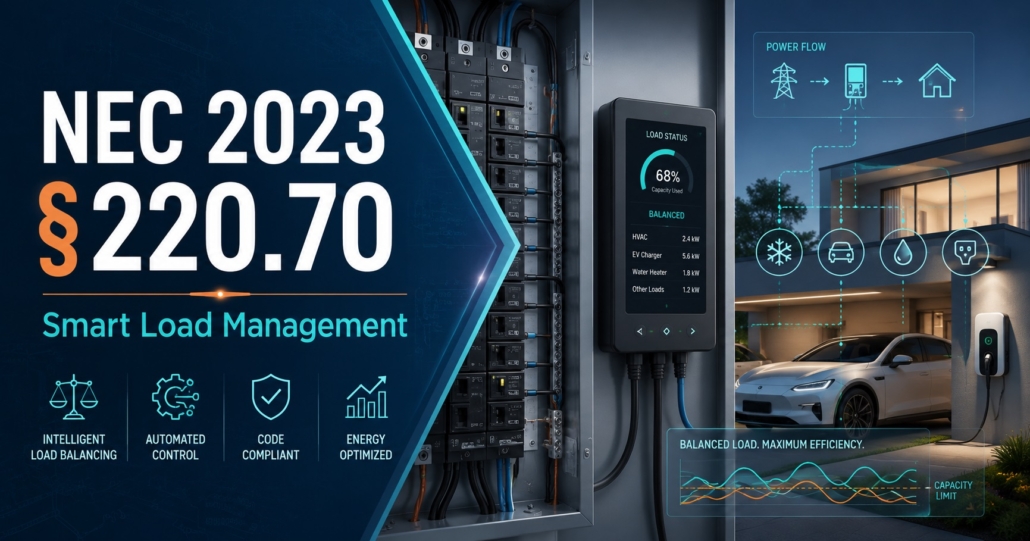
NEC 2023 Section 220.70: How Smart Load Management Is Transforming Electrical Design
As buildings become increasingly electrified, electrical designers face a growing challenge: adding new high-demand equipment without requiring costly service upgrades. Electric vehicle (EV) chargers, heat pumps, electric water heaters, battery energy storage systems, and induction cooking appliances can quickly consume available electrical capacity.
To address this challenge, the National Electrical Code (NEC) 2023 introduced Section 220.70, which recognizes the role of Energy Management Systems (EMS) in electrical load calculations. Rather than assuming all connected loads operate simultaneously, Section 220.70 allows designers to account for intelligent load management when sizing feeders and service conductors, provided the installation complies with applicable NEC requirements.
This represents an important step toward smarter, more efficient electrical system design while maintaining safety and reliability.
What Is NEC 2023 Section 220.70?
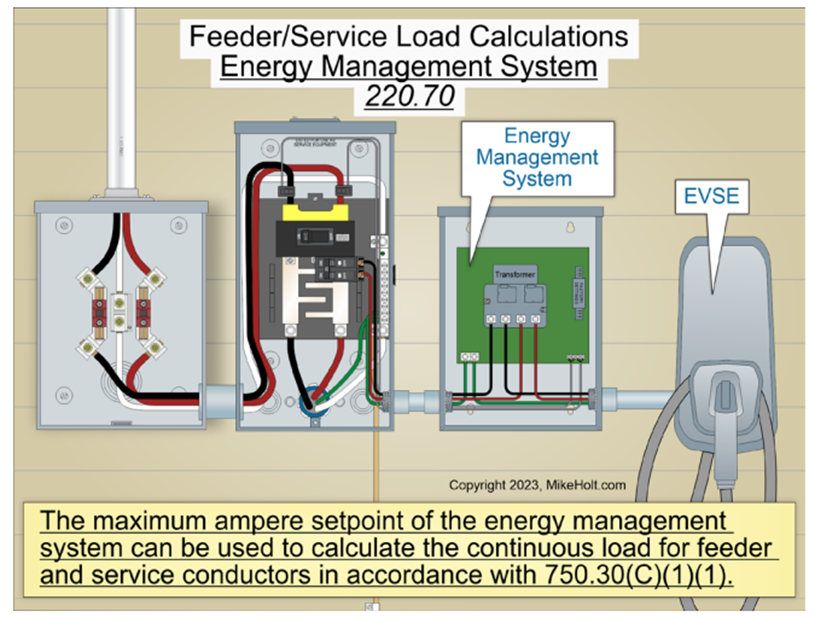
NEC 2023 Section 220.70 permits an approved Energy Management System (EMS) to be considered when determining the required size of electrical feeders and service conductors. An EMS continuously monitors electrical demand and automatically manages selected loads so the service rating is not exceeded.
Why Was Section 220.70 Added?
Traditional load calculations assume many large electrical loads may operate simultaneously, often resulting in oversized electrical services. Section 220.70 recognizes intelligent load management as a practical way to better utilize existing electrical infrastructure while maintaining safety.
How NEC Has Evolved to Support Energy Management
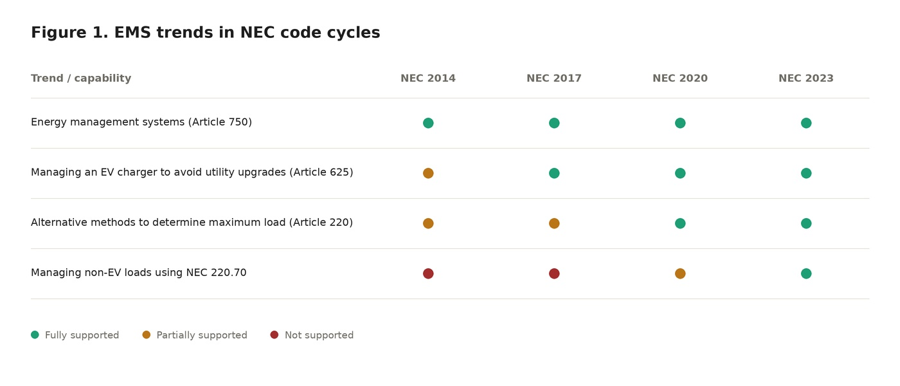
The NEC has progressively expanded its support for intelligent energy management over multiple code cycles. Please see Figure 1.
How Does an EMS Work?
An EMS monitors electrical demand in real time and automatically controls selected loads such as EV chargers, electric water heaters, HVAC equipment, and other controllable loads so the service rating is not exceeded.
Real-World Example
A home with a 200A service, 48A EV charger, 30A water heater, 40A heat pump, and household loads may require a service upgrade without an EMS. With an EMS, these loads are coordinated automatically to remain within the 200A service capacity.
Relationship Between Section 220.70 and Article 750
Section 220.70 allows EMS to be considered in load calculations, while Article 750 establishes the installation, operation, and safety requirements for Energy Management Systems.
What Loads Can Be Managed?
Examples include EV chargers, electric water heaters, HVAC systems, heat pumps, pool and spa equipment, electric space heating, and other controllable high-demand loads.
Benefits of NEC 220.70
• Reduce or defer costly service upgrades
• Maximize existing electrical capacity
• Lower installation costs
• Improve energy efficiency
• Simplify EV charger installations
• Support future electrification
The Future of Smart Electrical Design
As buildings become more electrified, intelligent load management will play an increasingly important role in designing safer, more efficient, and future-ready electrical systems.
Disclaimer
This article is for informational purposes only. Always consult the adopted NEC edition, local amendments, and the Authority Having Jurisdiction (AHJ) before applying these concepts.

Leave a Reply
Want to join the discussion?Feel free to contribute!