
Understanding NEC 2023 Energy Management Systems (EMS): A Practical Guide for Smarter Electrical Design
As residential and commercial electrical demand continues to increase with electric vehicles (EVs), heat pumps, electric water heaters, battery storage, and electrification, traditional service upgrades are becoming increasingly expensive and difficult. The National Electrical Code (NEC) 2023 recognizes this challenge by providing a framework for Energy Management Systems (EMS) that intelligently manage electrical loads while maintaining safe operation.
For homeowners, contractors, engineers, and manufacturers, Article 750 represents one of the most significant changes in modern electrical design.
What Is an Energy Management System (EMS)?
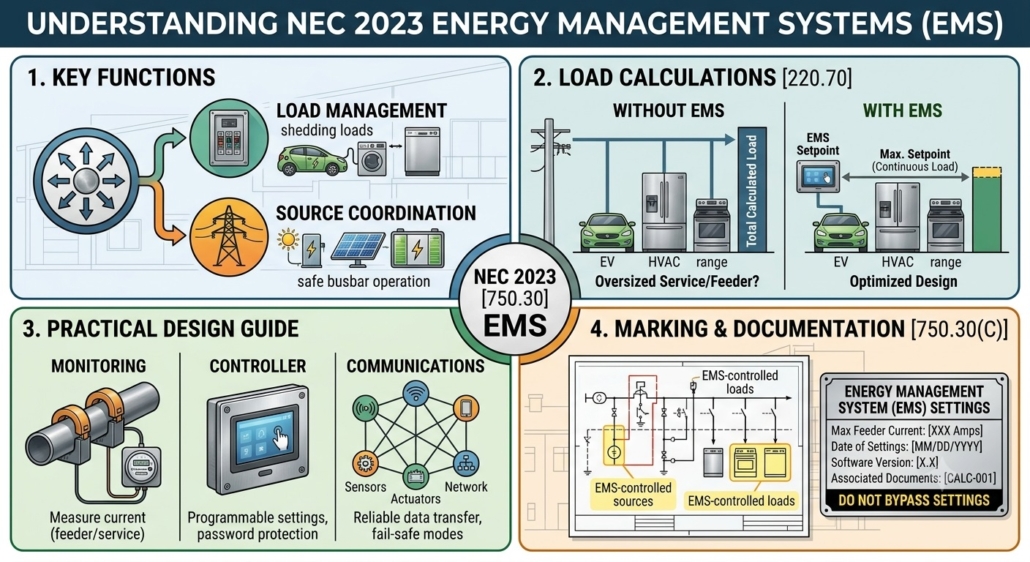
An Energy Management System (EMS) continuously monitors electrical demand and automatically controls selected loads to ensure that the service or feeder rating is not exceeded.
A modern EMS can monitor real-time demand, prioritize loads, temporarily reduce or delay nonessential loads, automatically restore loads when capacity becomes available, and optimize energy usage while maintaining electrical safety.
NEC 2023 Article 750
Article 750 is the primary NEC article governing Energy Management Systems.
Key sections include:
• 750.1 – Scope
• 750.30(A) – Listed or identified equipment
• 750.30(B) – Installation requirements
• 750.30(C) – Load management
• 750.30(C)(1) – Managed loads and feeder/service sizing
• 750.30(C)(2) – Control requirements
• 750.30(C)(3) – Fail-safe operation
Load Calculations Under NEC 2023
One of the most impactful features of Article 750 is its recognition of managed loads. When an EMS complies with Article 750 and automatically controls electrical demand, certain managed loads may not need to be included when sizing service conductors and feeders, provided all applicable NEC requirements are satisfied.
Examples include EV chargers, electric water heaters, HVAC equipment, heat pumps, pool and spa heaters, and other controllable high-demand loads.
Electric Vehicle Charging
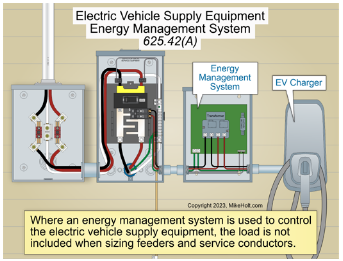
Article 625 governs Electric Vehicle Power Transfer Systems. Section 625.42(A) permits Automatic Load Management Systems (ALMS) that automatically adjust EV charging current based on available electrical capacity. When combined with an EMS complying with Article 750, EV charging can be intelligently managed.
Why EMS Matters
Without an EMS, adding new electric loads often requires larger electrical services, new conductors, utility upgrades, and higher installation costs. An EMS can often eliminate or postpone these upgrades by intelligently controlling demand.
Typical Managed Loads
Typical managed loads include EV chargers, electric water heaters, HVAC systems, heat pumps, pool equipment, spa heaters, and other nonessential electrical loads.
Benefits
• Lower installation costs
• Reduced need for utility upgrades
• Better utilization of existing electrical infrastructure
• Intelligent EV charging
• Future-ready electrical systems
• Enhanced grid flexibility
The Future of Smart Electrical Systems
As electrification accelerates, intelligent load management will become increasingly important. EMS technology enables electrical systems to be designed around controlled, real-time demand while maintaining compliance with NEC requirements.
Disclaimer
This article provides general information about NEC 2023. Always consult the adopted electrical code in your jurisdiction, applicable product listings, and the Authority Having Jurisdiction (AHJ) before applying any design or installation approach.

Leave a Reply
Want to join the discussion?Feel free to contribute!